
Physical surveillance is one of the most important and proven practices in the field of private investigation. It could be a matrimonial investigation, corporate scam, background checks, or missing persons; no database and no computer-based tool can offer an insight that is as real-time and factual as it can be uncovered by surveillance. An organized plan, adherence to the law, and knowledge in the field are utilized by a professional Detective Agency in Delhi in order to guarantee correct and unobtrusive results.
This blog takes a step-by-step approach to the physical surveillance involved in the private investigation and how the trained detectives can obtain the evidence without causing any inconvenience to the privacy or the law.
1. Recognizing the Requirement of the Client.
Any surveillance operation is initiated with a keen consultation. First, investigators attempt to know:
- Purpose of surveillance
- Identity of the subject
- Recognized addresses and routines.
- Duration of investigation
- Expected outcomes
As an illustration, in matrimonial cases, a client may require checking on the activities of a partner, whereas corporate clients may require evidence on the misconduct of an employee. A well-known Detective Agency in Delhi secures all the goals well established before work is commenced in the field.
This phase also entails signing confidentiality agreements and legal forms to ensure the privacy of a client.
2. Background Research and Intelligence Collection.
Before commencing physical tracking, the investigators carry out some initial research, and this might include:
- Social media analysis
- Employment verification
- Address confirmation
- Vehicle details
- Known associates
This intelligence assists detectives in mapping the lifestyle of the subject and in planning the surveillance efficiently. In the absence of this preparation, field surveillance is time-consuming and perilous.
Professional agencies may employ different teams of researchers so that field operatives can be provided with actionable information before going out on the street.
3. Strategy Planning Surveillance.
Surveillance is never haphazard–it is planned. Detectives plan it out depending on:
- Subject’s daily routine
- Travel patterns
- High-activity time slots
- Risk level
- Required manpower
The important aspects of planning are:
- Fixed location observation (fixed location surveillance).
- Following the subject of mobile surveillance.
- Undercover (as a member of the public/colleagues) surveillance.
One of the top Detective Agencies in Delhi is utilizing route mapping, shift rotations, and contingency plans to evade detection.
4. Team Deployment, Role Assessment.
Upon the finalization of the plan, the trained field operatives are appointed by the agencies. The roles of the members are well known:
- Lead investigator – plans the action.
- Mobile tail units – chase after the target.
- Fixed points – view fixed points.
- Documentation specialists – seize evidence.
With many operatives, fatigue is avoided, as well as the possibility of exposure. Cities that are metropolises, such as Delhi, need joint efforts to help ease traffic congestion in the areas.
5. Performing Static Surveillance.
A fixed vantage point is known as static surveillance, which involves viewing the subject at a fixed point:
- Residence vicinity
- Office location
- Parking areas
- Cafes or meeting spots
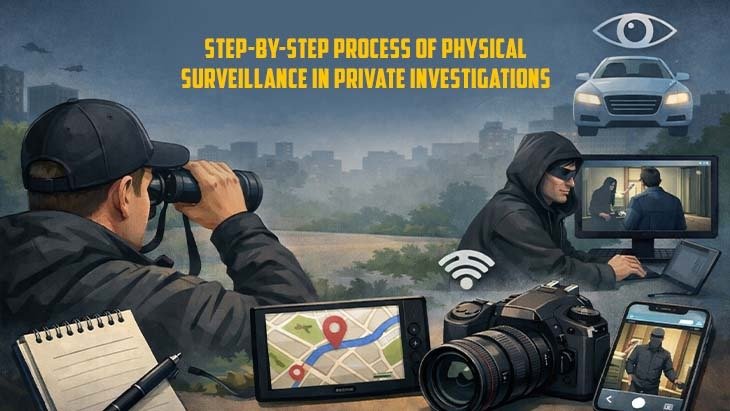
Step-by-Step Process of Physical Surveillance in Private Investigations
Detectives can work out of parked cars, rented offices, or open areas while having eye contact.
Key practices include:
- Maintaining a safe distance
- Avoiding eye contact
- Covert recording equipment.
- Logging entry/exit timings
Surveillance systems that remain in place tend to indicate the visitor practices, clandestine gatherings, or suspicious habits.
6. Mobile Surveillance (Shadowing the Subject)
Mobile surveillance commences upon the departure of the subject from the surveillance area. This is a very complicated phase.
The investigators can trace through:
- Motorbikes (to have flexibility in the traffic)
- Cars
- Public transport
- On foot in crowded areas
To avoid suspicion:
- Teams rotate vehicles
- Maintain a variable distance.
- Apply relay tracking (passing the tailing between operatives)
A professional Detective Agency based in Delhi trains agents on metropolitan areas, following the help of their techniques that can be used in busy markets, metro stations, and corporate centers.
7. Documentation of Evidence Collection.
The value of surveillance can only be achieved when evidence is well-documented. Investigators gather:
- Photographs
- Videos
- Sound bites (where permitted by law)
- Time-stamped activity logs
- Location records
There is high-resolution and covert equipment that captures all the material. Documentation must be:
- Clear
- Legally obtained
- Chronologically organized
- Tamper-proof
Such evidence can be used in future legal, corporate, or personal judgments.
8. Ensuring Legal Compliance and Ethics.
The physical surveillance should be within the law. In ethical detective agencies, it guarantees:
- No encroachment into personal property.
- No illegal phone tapping
- None of the unauthorized digital hacking.
- None of harassment or confrontation.
The privacy laws and rules of Indian investigations are observed by a professional Detective Agency in Delhi so that evidence could be used and clients could not involved into any legal issues.
9. Daily Reports and Customer communications.
In long surveillance, the clients are updated regularly, such as:
- Daily activity summaries
- Photographic highlights
- Movement logs
- Behavioral observations
Nevertheless, confidential information is disseminated in a safe way that keeps the operations a secret. Agencies do not disclose in real time, which may be a threat to the investigation.
10. Preparation of Final Analysis and Report.
Upon the end of the surveillance, the detectives prepare a summative report that entails:
- Case objective recap
- Day after day of surveillance.
- Subject activity timeline
- Visual evidence annexures
- Investigator observations
- Conclusion summary
Reporting is organized clearly and can be applied in:
- Court submissions
- Corporate HR action
- Matrimonial decisions
- Internal risk assessments
The best agencies make reports real, objective, and professionally standardized.
11. Post-Investigation Confidentiality
With the report, confidentiality is not over. Ethical investigators:
- Securely archive evidence
- Restrict data access
- Do not disclose to a third party.
- Erase information when ordered to do so (where feasible)
The strength behind the private investigations is trust, and discretion is the safeguard of both the client and the reputation of the agency.
Physical Surveillance Problems.
Despite planning, detectives are challenged by real-life issues:
- Traffic jams and overcrowding.
- Subject counter-surveillance consciousness.
- Weather disruptions
- Legal sensitivities
- Long operational hours
This is the reason why it is important to employ an experienced Detective Agency in Delhi; they have local knowledge of the terrain, a trained labour force, and adaptive tactics.
When do we need Physical Surveillance?
Common cases include:
- Pre-matrimonial investigations
- Post marital infidelity examination.
- Background check of the employees.
- Corporate espionage prevention.
- Insurance fraud
- Teen monitoring
- Missing person tracking
The cases require tailored surveillance planning, not a one-size-fits-all surveillance plan.
Conclusion
Surveillance is one of the strongest investigative aids in the case of private detectives Contact. Each step, starting with the initial consultation up to the final reporting, must be precise, patient, and professional. It is a matter of research, planning, undercover observation, legal requirements, and record keeping–all without a hitch.
Considering the fame of the Detective Agency in Delhi, it means that investigations will be carried out in a discreet, ethical, and effective manner. Clients can get credible information to make quality personal, legal, or business decisions with trained operatives and structured methodologies.