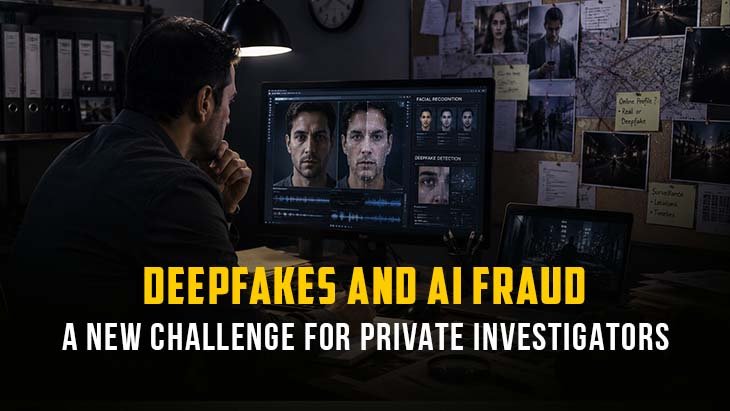
AI has revolutionised businesses across all domains, from operations to communication and decision-making. This technology has also facilitated cybercriminals to develop more sophisticated scams that are harder to spot. Deepfake fraud is among the largest threats being faced by investigators, businesses and law enforcement agencies around the world.
CEO voice cloning is just one recent example of the use of AI to defraud, as scammers create voice conversations with deceptive executives and fake video footage in court cases. This change has resulted in a great demand for services focused on deepfake fraud investigation services in India, integrating digital forensics, cyber intelligence, and traditional investigative methods.
Organisations are coming under more pressure in India, where digital payments, remote working, online identity verification, and AI use are all on the rise, for AI-fuelled deception. Now, private investigators, compliance officers, lawyers, and corporate security personnel need specialised approaches to verifying digital evidence before making decisions. Today, private investigators, compliance officers, lawyers and corporate security teams need to employ specific techniques to confirm digital evidence to make decisions.
The guide examines the workings of deepfake technology, the latest trends in AI fraud in India, investigative tools, legal issues, and how detectives verify deepfake videos in 2026 using the latest forensic tools and evidence validation techniques in 2026.
Understanding Deepfakes and AI Fraud
Deepfakes are the process of digitally altering an image, video or audio recording by using AI models, especially deep learning and generative AI systems. The models learn facial expressions, voice qualities, speech patterns and body movements and create highly convincing synthetic media.
Unlike conventional photo editing, modern deepfakes can create a likeness of a person’s appearance and voice with a very high degree of realism and are very hard to detect by the general public.
AI fraud goes beyond fake videos and encompasses:
- AI-generated voice cloning
- Synthetic identity creation
- Fake video conference participants
- Forged legal evidence
- AI-written phishing emails
- Automated financial scams
- Deepfake customer verification attacks
- Business Email Compromise (BEC) enhanced with AI
How to figure out if digital evidence exists is becoming less of a problem for investigators; how to make sure it is authentic is more.
Why Deepfake Fraud Is Becoming a Major Investigation Challenge
Thanks to artificial intelligence, there is no longer any reason to think that fake content is impossible to make.
There are several reasons why AI-powered fraud is on the rise:
- Free and inexpensive AI generation tools
- Publicly available social media content used for training
- High-quality voice cloning technology
- Faster video generation models
- Remote hiring and virtual meetings
- Digital document verification processes
- Increased reliance on online evidence
The scammers don’t have to be very technically skilled. There are now many AI tools that can create convincing fake content within the blink of an eye these days.
As private investigators get increasingly exposed to fake evidence in situations such as:
- Matrimonial investigations
- Corporate disputes
- Insurance fraud
- Employee misconduct inquiries
- Financial investigations
- Intellectual property Investigation
- Cybercrime investigations
Types of Deepfake Fraud Affecting India
Corporate Executive Impersonation
Impersonating the voice or image of key figures to approve payments or information releases.
These attacks are typically found in banks’ finance departments when they are urgently requesting payments.
Fake Video Evidence
Video or video clips that have been manipulated or edited can be introduced in legal proceedings, a workplace investigation or civil proceedings.
The professional investigator(s) will need to help identify:
- Whether edits occurred
- Original recording source
- Compression history
- Metadata integrity
- Device authenticity
Voice Cloning Scams
Fraudsters can create realistic-sounding calls of:
- Family members
- Business owners
- Company executives
- Lawyers
- Government officials
Emergency calls for funds or for private information are often made to victims.
Identity Verification Fraud
Banks, fintech and online platforms are becoming more and more reliant on video KYC.
Deepfake technology tries to fool the face verification systems by using AI-generated faces or manipulated live streams.
Employment Verification Fraud
Applicants can use videos created with AI to appear in a virtual interview, or use AI to alter identity documents.
More firms using investigators for independent background checks are doing so when hiring executives.
Industries Most Vulnerable to AI Fraud
Several sectors are vulnerable to a higher exposure:
Financial Services
- Banking fraud
- Loan verification
- Identity theft
- Investment scams
Insurance
- False claims
- Manipulated accident evidence
- Fake medical documentation
Corporate Sector
- Vendor fraud
- Procurement scams
- Insider threats
- Executive impersonation
Legal Profession
- Digital evidence validation
- Witness verification
- Audio authentication
Matrimonial Investigations
- Fake identity profiles
- Edited personal videos
- False background claims
Government Agencies
- Identity fraud
- Public document manipulation
- Election misinformation
The Role of Private Investigators in Deepfake Fraud Investigation
Private investigators have evolved far beyond traditional surveillance.
Today’s investigators combine:
- Digital forensics
- Cyber intelligence
- Metadata analysis
- Open-source intelligence (OSINT)
- Background investigations
- Device examination
- Interview techniques
- Legal evidence preservation
Investigators do not need to depend on one piece of evidence; they need to check them by several different sources to validate it before they draw a conclusion.
The multi-layered architecture also helps to minimise the number of false positives.
How Detectives Verify Deepfake Videos in 2026
As one of the most frequently asked questions by businesses, how detectives verify deepfake videos in 2026 remains a subject of inquiry. Current investigations include the use of forensic science, AI-based analysis and human knowledge to establish authenticity.
Metadata Examination
Investigators first review:
- Creation timestamps
- Editing history
- Device information
- GPS data (when available)
- Software signatures
- File integrity
Inconsistencies in metadata are usually a sign of manipulation; however, advanced attackers can manipulate or delete metadata.
Compression Artefact Analysis
All videos are compressed.
Investigators examine:
- Encoding patterns
- Frame inconsistencies
- Pixel anomalies
- Unexpected recompression
- Duplicate artifacts
These are often signs of post-production work.
Facial Landmark Detection
While AI face generation can sometimes face difficulties with:
- Natural blinking
- Lip synchronisation
- Eye reflections
- Facial symmetry
- Skin texture continuity
Forensic software is used by investigators to identify subtle irregularities that are undetectable to the human eye.
Audio Forensics
Voice cloning analysis consists of:
- Frequency comparison
- Background noise consistency
- Spectrogram analysis
- Breathing patterns
- Speech cadence
- Digital artifacts
Professional audio examination is still one of the best ways of detecting synthetic speech.
Source Verification
Investigators verify:
- Original recording devices
- Upload history
- Cloud backups
- CCTV originals
- Witness copies
If possible, it’s better to find the source file rather than a forwarded version.
Cross-Platform Intelligence
Investigators make comparisons of content between:
- Social media
- Corporate systems
- Email records
- CCTV archives
- Mobile devices
- Cloud storage
Cross-verification is a way of reinforcing the reliability of the evidence.
AI Scam Detection India – Best Practices for Organizations
Relying solely on technology should not be an organisation’s strategy.
A comprehensive AI scam detection India strategy includes:
Building awareness among employees through training
Employee Awareness Training
- AI-generated voice requests
- Fake emergency calls
- Deepfake executive videos
- Suspicious payment instructions
- Social engineering tactics
The first line of defence is human awareness!
Multi-Factor Verification
Before adopting a PDM, organisations should insist that it be independently verified that it:
- Large fund transfers
- Vendor account changes
- Confidential document sharing
- Executive approvals
Strong Identity Verification
Verification should include:
- Live facial authentication
- Government-issued identification
- Device reputation checks
- Behavioural biometrics
Incident Response Planning
It should be the task of the organisation to develop processes for:
- Preserving evidence
- Reporting incidents
- Engaging forensic experts
- Coordinating with legal teams
- Supporting law enforcement investigations
Digital Forensic Techniques Used During Deepfake Fraud Investigation
Professional investigators use known forensic principles instead of ‘assumptions’.
Several methods for investigation are followed:
- File hash verification
- Chain of custody documentation
- Device imaging
- Log analysis
- Network examination
- Cloud artefact recovery
- Deleted file recovery
- Timeline reconstruction
- Behavioural pattern analysis
All techniques help to create a determination of trust in the digital evidence.
Legal Considerations in India
India’s legal landscape is constantly adapting to the advancement of AI.
Investigators must always keep in mind:
- Information Technology Act provisions related to cyber offences
- Bharatiya Nyaya Sanhita (BNS) provisions addressing cheating, forgery, identity-related offences, and electronic evidence
- Bharatiya Sakshya Adhiniyam (BSA) provisions governing the admissibility and authentication of electronic evidence
- Digital Personal Data Protection Act (DPDP Act) obligations regarding lawful processing of personal data
- Sector-specific RBI, SEBI, CERT-In, and corporate cybersecurity guidelines where applicable
Given that AI fraud can often cross a multitude of legal jurisdictions, investigators must collaborate with legal experts before presenting digital evidence before a court in litigation.
Please note: Laws and guidance will change. Depending on the facts of the case, jurisdiction and subsequent amendments, the applicable legal framework can be different. This article is not intended to be legal advice.
EEAT Principles in Deepfake Fraud Investigations
When handling digital evidence, trust is a key factor.
Established investigators enhance credibility by:
Demonstrating Expertise
Professional investigators are continually learning about:
- Digital forensics
- Artificial intelligence
- Cyber investigations
- Electronic evidence handling
- Interview techniques
- Fraud risk assessment
Establishing Authoritativeness
A key to authoritative investigations is:
- Standardised forensic methodologies
- Documented evidence handling procedures
- Independent verification
- Expert reporting
- Collaboration with legal professionals and certified forensic specialists where required
Building Trust
Clients expect:
- Confidentiality
- Transparent reporting
- Ethical investigation practices
- Lawful evidence collection
- Objective findings
- Proper documentation
Investigators should refrain from concluding without supporting it with the facts and differentiate between the facts and what they have observed.
Practical Case Examples
Corporate Payment Fraud
A company gets a video call that looks like it’s from their Managing Director requesting immediate payment from a vendor. The finance team would go through internal verification procedures, verify the request via another means of communication and find that the caller created a video using AI. The incident is recorded, digital artefacts are saved, and investigators help in the tracing of the fraudulent communication.
Key takeaway: An independent verification process can avoid serious financial losses.
Fake Evidence in Employment Disputes
A staff member provides a video recording of wrongful behaviour at work. Investigators analyse the metadata, match the timestamps with access control records, check cameras and see if there are any irregularities in compression and sequencing. Before submission, the video is identified as altered.
Key takeaway: Digital evidence must always be backed up with several independent sources.
Executive Voice Impersonation
The finance department gets a call that sounds like the CEO’s voice, and orders a transfer to a foreign account to be made immediately. Later, investigators figure out that the voice is artificial intelligence software taking on the speech of public speakers and interviews.
Key takeaway: Approvals of this nature that involve substantial amounts of money should be made by multiple people and verified outside of the system.
Best Practices for Businesses to Reduce AI Fraud Risks
There are layered controls that can help organisations build resilience:
- Develop an AI-aware fraud risk management policy.
- Train employees to identify synthetic media and social engineering.
- Require dual authorisation for sensitive financial transactions.
- Preserve original digital files rather than relying on forwarded copies.
- Maintain detailed audit logs for critical systems.
- Regularly review access controls and privileged accounts.
- Conduct periodic cybersecurity and fraud response exercises.
- Engage qualified investigators promptly when suspicious digital evidence is identified.
A combination of technology, governance and employee awareness provides more protection than technology alone.
Frequently Asked Questions (FAQs)
1. What is a deepfake fraud investigation?
Deepfake Fraud Investigation entails analysing videos, audio, images, and digital records to ascertain authenticity, which may have been altered or generated using AI. Forensic analysis, metadata analysis, source verification and corroborating evidence are used to determine manipulation.
2. How can businesses detect AI-generated scams in India?
There are several ways businesses can enhance AI scam detection in India, such as educating employees about scams, enabling multi-factor verification, implementing digital forensic tools, establishing secure workflows for approvals, and promptly reporting suspicious activity to a business security team and the appropriate authorities.
3. How do detectives verify deepfake videos in 2026?
Current investigators study the metadata, facial features, compression artefacts, audio attributes, device details, source data, and other data from several systems. There is no single test to determine authenticity, and the evidence is drawn from a thorough and forensic examination.
4. Can deepfake videos be used as legal evidence in India?
Electronic evidence may be admissible as long as it meets legal requirements for authenticity, integrity and admissibility. The reliability of the evidence is considered by the courts, and sometimes a forensic examination of the evidence is required to establish credibility.
5. When should an organisation hire a private investigator for AI fraud?
Having a qualified investigator available to assist your organisation with suspicious videos, voice recordings, data tampering, identity theft, executive impersonation, independent fact-finding, and forensic documentation of the incident is a valuable resource to consider.
Key Takeaways for Investigators and Organisations
Artificial Intelligence has revolutionised the world of fraud! Deepfake videos, voice cloning, fake identities, and social engineering with artificial intelligence are no longer just cyber incidents—they are now viable tools that can be used to take advantage of trust in the company, legal, financial, and personal spheres. With increasing sophistication of these threats, Contact deepfake fraud investigation the increasing sophistication of these threats, the Contact deepfake fraud investigation service goesat the face. It requires strict processes of forensic investigation, meticulous evidence preservation, cross-verification of digital artefacts, and collaboration among investigators, cybersecurity experts and legal professionals.
Enhancing AI scam detection in India is just one component of a comprehensive fraud prevention plan that involves employee education, thorough verification protocols, secure digital processes, and swift investigative assistance. Similarly, how detectives verify deepfake videos in 2026 reminds us of an important point: Authentic digital evidence is created through systematic analysis and not assumption. To mitigate this, businesses and professionals must invest in the development of their investigative skills, ensure robust internal controls, and be aware of the changing landscape of AI tools and legalities. To safeguard themselves, businesses and professionals should invest in strengthening their investigative abilities, establish effective internal controls, and keep abreast of legal and regulatory developments and emerging AI tools and technologies.