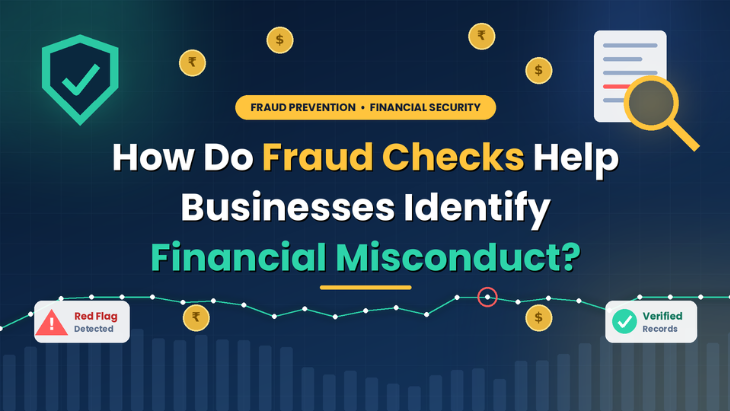
Financial fraud investigation for companies in India helps businesses identify suspicious activities, verify concerns involving employees or external parties, and understand potential financial misconduct before it causes further damage. Fraud checks can reveal warning signs such as false expense claims, vendor irregularities, employee conflicts of interest and suspected misuse of company assets. By combining internal controls with lawful background verification, due diligence and professional corporate investigation, businesses can make better-informed decisions based on verified information rather than assumptions.
What Are Fraud Checks?
Fraud checks are verification activities that help businesses identify inconsistencies, suspicious relationships and possible dishonest practices involving employees, vendors, business partners or other associated parties.
In a corporate environment, these checks may involve reviewing information supplied by the company, verifying identities and business backgrounds, checking relevant public information and investigating specific concerns through lawful enquiries.
Corporate fraud checks generally focus on two areas:
- Preventive checks: Verifying employees, vendors, contractors and business partners before entering into professional relationships.
- Investigative checks: Examining specific concerns when suspicious transactions, missing assets, false claims or employee misconduct are reported.
Fraud checks do not replace financial audits or internal accounting controls. Instead, they can complement these activities by helping management establish relevant facts about people, business relationships and suspected misconduct.
Common Types of Financial Misconduct in Companies
Financial misconduct can occur at different levels of an organisation. It may involve employees, managers, suppliers or external business associates.
Some common examples include:
1. Expense and Reimbursement Fraud
An employee may submit duplicate bills, inflated travel expenses or claims for purchases that were never made. Repeated discrepancies in reimbursement requests can indicate a need for further verification.
2. Vendor and Billing Fraud
A manager approving invoices from a vendor with whom they have a personal relationship may create a conflict of interest. Other concerns include fictitious suppliers, inflated invoices and payments for goods or services that were never delivered.
3. Payroll Irregularities
Companies may encounter discrepancies involving employee attendance, duplicate payroll entries, unauthorised salary changes or payments associated with individuals whose employment details cannot be verified.
4. Misappropriation of Company Assets
Misappropriation involves the unauthorised use, transfer or disposal of company property. This may include inventory, equipment, vehicles or other business resources.
5. Conflicts of Interest
An employee or senior manager may have an undisclosed financial interest in a supplier, competitor or business partner. Such relationships can influence purchasing decisions and create opportunities for misconduct.
6. Falsified Business Information
Manipulated documents, inconsistent employment details, misleading vendor information or false business credentials may affect important financial and operational decisions.
These situations do not automatically establish fraud. They indicate areas where businesses may need additional verification.
What a Financial Fraud Investigation for Companies in India Helps Identify Financial Misconduct
A financial fraud investigation for companies in India can help management understand suspicious circumstances by independently verifying relevant information, identifying relationships and documenting factual observations.
Here are six important ways these investigations can support businesses.
1. Verifying Employee and Business Backgrounds
A person’s professional background and business relationships can influence an organisation’s financial security.
For example, a company may discover inconsistencies in an employee’s previous employment details or have concerns about a prospective vendor’s business credentials.
Professional background verification and due diligence can help establish whether the available information is consistent with the claims made by the individual or organisation.
Businesses can consider pre-employment investigation services when verifying individuals for sensitive positions involving finance, procurement or confidential business information.
2. Identifying Suspicious Relationships
Financial misconduct does not always involve direct theft. Sometimes, it involves undisclosed connections between employees and external parties.
For example, a procurement manager may repeatedly recommend a particular supplier despite concerns about pricing or service quality.
A corporate investigation can help examine relevant business associations and verify information about the individuals or entities involved, using lawful and accessible sources.
This can help management understand whether a potential conflict of interest requires further attention.
3. Identifying Warning Signs Around Company Assets
Missing inventory, unexplained equipment transfers and suspected misuse of company property can indicate possible internal misconduct.
A company asset investigation can help verify the existence, location and relevant ownership details of assets through lawful information-gathering activities.
It may also help businesses investigate concerns involving company property and identify information that requires further review.
4. Cross-Checking Information Against Available Facts
One suspicious document or employee statement is not enough to establish financial misconduct.
Investigators can compare information supplied by the company with independently verifiable details, relevant public records and lawful field enquiries.
For example, if a business suspects that a vendor has misrepresented its operating presence, relevant business details and available information about its operations may be checked.
The objective is to identify inconsistencies and establish a clearer picture of the circumstances.
5. Understanding Possible Bank and Payment-Related Fraud
Bank fraud investigation is an important topic when discussing corporate financial risks because suspicious banking or payment activities can affect a company’s finances.
Examples include unauthorised payment instructions, impersonation of authorised personnel, suspicious beneficiary changes and misleading payment requests.
Businesses should involve their banks and appropriate financial professionals when investigating actual banking transactions. Chartered accountants, auditors and authorised institutions are better placed to examine financial records and transaction details.
A private investigation agency does not independently access confidential bank records or conduct forensic accounting. Its role may be limited to lawful background verification, relevant field enquiries and information gathering concerning associated individuals or entities.
6. Documenting Findings for Better Business Decisions
An investigation becomes more useful when the findings are organised and supported by relevant information.
A factual report can help management understand:
- What concern was investigated.
- Which details could be independently verified.
- What inconsistencies or relevant observations were identified.
- Which areas require further examination.
- What limitations affected the investigation.
Such documentation can support internal reviews and help businesses decide whether to involve auditors, chartered accountants or legal professionals.
Warning Signs That a Business Should Look Into
Businesses should pay attention to repeated irregularities rather than relying on a single suspicious incident.
Some warning signs include:
- Unexplained financial discrepancies: Differences between reported business activities and available supporting information.
- Repeated vendor changes: Frequent changes in suppliers without a clear business reason.
- Unusual employee behaviour: Employees avoiding verification procedures or providing inconsistent explanations.
- Missing company property: Repeated loss of inventory, equipment or other business assets.
- Unusual business relationships: Employees maintaining undisclosed connections with suppliers or competitors.
- Inconsistent documentation: Differences in invoices, employee credentials, vendor details or other business documents.
- Unexplained approval patterns: One individual repeatedly controlling vendor selection, approvals and related activities without adequate oversight.
These warning signs should be assessed objectively. Businesses should first preserve relevant internal records and follow their established reporting and investigation procedures.
How Does a Financial Fraud Investigation Usually Work?
A professional investigation generally follows a structured approach based on the concern, available information and agreed scope of work.
1. Initial Case Assessment
The investigation begins with a discussion about the suspected misconduct. The business explains what happened, when the concern was identified and what information is already available.
The investigator assesses whether the matter is suitable for private investigation.
2. Defining the Investigation Scope
The next step is to establish the investigation objectives, relevant individuals or entities, expected activities and limitations.
A written agreement should clarify the scope of work before the investigation begins.
3. Lawful Information Gathering
Depending on the case, investigators may conduct:
- Background and identity verification.
- Business and vendor background enquiries.
- Verification of relevant publicly available information.
- Lawful field enquiries and observations.
- Relevant employee or external-party enquiries.
- Verification of company asset-related information.
The investigation must respect applicable laws, privacy requirements and the agreed scope.
4. Interviews and Field Enquiries
Where appropriate, investigators may make relevant enquiries with individuals or examine business-related circumstances to verify specific concerns.
The purpose is to gather factual information without making assumptions about someone’s involvement.
5. Documentation and Reporting
After completing the agreed activities, findings are organised into a factual report.
The report may include relevant observations, verification details, supporting documentation and limitations.
6. Further Review and Next Steps
Businesses can share relevant findings with their internal finance, HR or compliance teams.
If the matter involves accounting discrepancies, financial transactions or possible legal violations, qualified chartered accountants, auditors and lawyers should be involved as appropriate.
Important: A private investigation agency does not replace a forensic auditor, chartered accountant, bank investigator or lawyer. Its contribution is limited to the agreed, lawful investigation and information-gathering activities.
When Should a Business Involve a Professional Investigation Agency?
Businesses should consider professional investigative assistance when internal verification does not provide sufficient clarity or when a concern requires independent field enquiries.
An investigation agency may be useful when:
- An employee is suspected of misusing company resources.
- A business partner’s background raises concerns.
- A vendor’s identity or business claims require verification.
- Company assets are suspected of being misappropriated.
- An employee’s professional information appears inconsistent.
- There are concerns about undisclosed business relationships.
- Management needs confidential verification of specific allegations.
However, not every financial irregularity requires a private investigator.
If the concern involves incorrect accounting entries, financial statement manipulation, tax discrepancies or transaction reconciliation, businesses should consult qualified accountants and auditors first.
Where criminal activity or legal action is suspected, a qualified lawyer and the appropriate authorities should be involved.
Advance Detective Agency Pvt. Ltd. (ADA) provides corporate investigation, due diligence, company asset investigation and employment verification services. Founded in Delhi in 2013, the agency provides confidential investigation services with pan-India reach.
Its approach focuses on understanding the client’s concern, defining the investigation scope and gathering relevant information within lawful limits.
Frequently Asked Questions About Fraud Checks
1. What is fraud checks in a company?
Fraud checks are verification activities designed to identify suspicious behaviour, false information, financial irregularities and possible misconduct involving employees, vendors or business partners. They may include background verification, due diligence and internal investigations to help businesses establish facts and identify potential risks.
2. How can companies identify internal financial fraud?
Companies can identify possible internal financial fraud by monitoring unusual expense claims, unexplained asset losses, suspicious vendor relationships, payroll discrepancies and inconsistent business documentation. Internal audits and professional investigations can help establish whether these warning signs require further examination.
3. What is the difference between a financial audit and a financial fraud investigation?
A financial audit examines financial statements, accounting records and reporting procedures. A financial fraud investigation focuses on specific suspicions of misconduct and gathers relevant information to understand what happened. Auditors and forensic accountants handle financial examination, while private investigators can support enquiries through lawful background and field verification.
4. Can a private detective agency investigate employee fraud in India?
A private detective agency can assist businesses with suspected employee misconduct through relevant background verification, lawful field enquiries, business relationship checks and factual documentation. Its activities must remain within applicable legal and privacy boundaries. Financial record examination and legal proceedings require the appropriate qualified professionals.
5. What should a business do after discovering suspected financial misconduct?
A business should preserve relevant records, document the concern and follow its internal reporting procedures. It should involve its finance, compliance or audit team to assess the issue. If independent verification is required, professional investigators may assist within an agreed scope. Legal concerns should be discussed with a qualified lawyer.
Speak With Advance Detective Agency About Your Corporate Investigation Requirements
Suspected financial misconduct deserves careful examination, not assumptions. If your business has concerns involving employee activities, vendor relationships, company assets or possible internal fraud, professional verification can help establish relevant facts.
Advance Detective Agency offers a free, confidential initial consultation to understand your concerns, explain what is possible and discuss an appropriate investigation scope.
- Phone/WhatsApp: +91 88827 32221
- Email: info@advancedetectiveagency.com
Contact ADA to discuss your corporate investigation requirements.
Expert Leadership of Advance Detective Agency
Under the leadership of Hardesh Bhardwaj who is the Founder and Director of the Advance Detective Agency since 2013, this organization offers professional investigation for private matters such as divorce investigation, marital enquiry, infidelity investigation and background verification.
The experience of conducting more than 3,000 cases himself gives practical experience with the cases, which can require help for clarification of marital issues and disputed information. The leader has the experience of applying professionalism in the process of conducting matrimonial investigation, which requires discreet enquires, legitimate information gathering and confidentiality.
In 2026, Hardesh Bhardwaj was awarded the title of Investigator of the Year by the World Association of Detectives (WAD) at its annual convention in Cannes. Founded in 1925, the WAD is an old international association which serves private investigators.