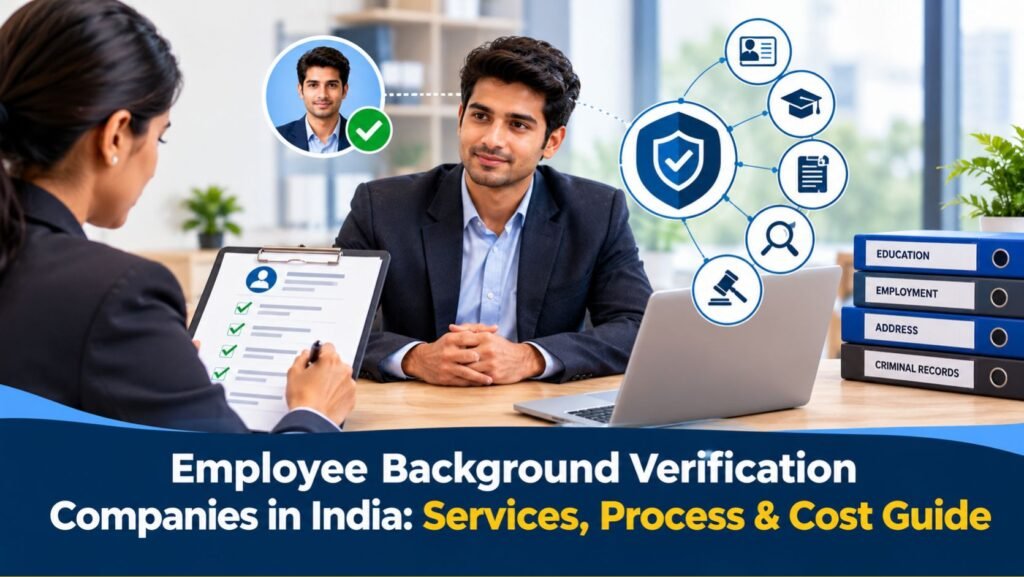
Employee Background Verification Companies in India: Services, Process & Cost Guide
Before or after hiring, Indian employee background verification businesses verify a candidate’s identification, work history, education, residence, and criminal records. Using legal, documented procedures and candidate consent, they assist companies in lowering hiring risk, verifying resume accuracy, and safeguarding the workplace against fraud.
Hiring the wrong person can cost a company far more than delayed joining date. A single fabricated degree, hidden criminal case, or false employment claim can lead to financial loss, reputational damage, or workplace safety issues. This is why more Indian businesses — from startups to large enterprises — now rely on professional background verification before finalizing a hire.
This guide explains what employee background verification companies do, how the process works, what it costs, and how to choose the right verification partner for your organization.
What Is Employee Background Verification?
Verifying the accuracy and veracity of the information an applicant has submitted is known as employee background verification. It typically covers identity, past employment, educational qualifications, address, and criminal history.
Companies use background verification to:
- Confirm a candidate is who they claim to be
- Validate work experience and job titles mentioned in the resume
- Check educational degrees and certifications
- Screen for criminal records or pending legal cases
- Verify current and permanent address details
Verification can happen before onboarding (pre-employment) or after an employee has already joined (post-employment), depending on the company’s HR policy and the role’s sensitivity.
Why Employee Background Verification Matters
Background checks are not just a formality. They directly affect business safety, compliance, and trust.
Reduces hiring risk: Verification catches false claims before they become a company’s problem, especially for roles involving finance, client access, or sensitive data.
Protects workplace safety: Employers handling customer-facing roles, security-sensitive positions, or work-from-home arrangements benefit from knowing who they are hiring.
Supports compliance: Many industries — BFSI, IT/ITES, healthcare, logistics — require documented background checks as part of internal risk policy or client contractual obligations.
Builds long-term trust: A verified workforce reduces internal fraud risk and supports a more accountable work culture.
Prevents resume fraud: Fake degrees, inflated designations, and fabricated experience letters are more common than most HR teams expect, and verification is the most reliable way to catch them.
Types of Employee Background Checks Companies Offer
Most employee background verification companies in India offer a mix of the following checks, which can be customized based on the role and industry.
Identity Verification
Confirms the candidate’s identity using government-issued documents such as Aadhaar, PAN, passport, or voter ID.
Address Verification
Confirms current and permanent residential address through documentation or physical/digital verification methods.
Employment History Verification
Confirms previous job titles, employment dates, reason for leaving, and sometimes performance feedback from past employers, based on records and consented references.
Education Verification
Confirms degrees, diplomas, and certifications directly with the issuing institution or university.
Criminal Record Check
Checks court records and police verification databases for pending or past criminal cases linked to the candidate, where such records are lawfully accessible.
Reference Check
Involves speaking with professional references provided by the candidate to understand work conduct and reliability.
Database and Court Record Checks
Cross-checks public court records and other lawfully available databases relevant to the candidate’s background.
Employers usually select a combination of these checks depending on the seniority of the role, industry regulations, and internal risk policy — rather than running every check for every position.
How the Employee Background Verification Process Works
The process generally follows a structured, step-by-step approach:
Candidate consent
The candidate is informed and provides written consent for the background check, in line with data privacy expectations.
Document collection
ID proof, address proof, educational certificates, and employment letters are collected from the candidate or employer.
Verification request
The verification company contacts educational institutions, previous employers, or relevant authorities to confirm the details.
Cross-checking information
Data provided by the candidate is compared against verified sources and records.
Report compilation
Findings are compiled into a structured report highlighting matches, discrepancies, or red flags.
Report delivery
The report is shared with the hiring company’s HR or compliance team for a final decision.
Timelines vary depending on how quickly institutions, employers, or authorities respond, and on how many checks are included in the verification package.
Documents and Information Typically Required
To carry out a background check, verification companies generally need:
- Government-issued ID proof (Aadhaar, PAN, passport, etc.)
- Address proof (utility bill, rental agreement, etc.)
- Educational certificates and mark sheets
- Previous employment letters (offer letter, relieving letter, salary slips)
- Candidate’s written consent for verification
- Reference contact details, where applicable
Having these documents ready in advance helps speed up the verification timeline.
Cost of Employee Background Verification in India
Background verification costs vary based on:
- The number of checks included (identity, address, education, employment, criminal record, etc.)
- The candidate’s seniority level — senior or leadership roles often require deeper checks
- Location-based factors, such as verifying education or employment across multiple cities
- Whether checks are done individually or as a bundled package
- The turnaround time requested
Because pricing depends heavily on scope, it’s best to request a customized quote based on the specific role and checks required rather than relying on a fixed, generic figure.
Common Concerns Employers Have About Background Verification
Is it permissible to verify a candidate’s background?
Yes, provided that it is carried out with the candidate’s informed agreement and using legal techniques including institutional confirmation, document verification, and publicly available records.
Will this delay the hiring process?
A well-planned verification process, run in parallel with other onboarding steps, usually does not cause significant delays.
What if a discrepancy is found?
A discrepancy doesn’t always mean intentional fraud — sometimes it’s a clerical or record-keeping error. Employers typically give the candidate a chance to clarify before making a final decision.
Is candidate data kept confidential?
A reliable verification partner should handle candidate documents and personal data with confidentiality and use them only for the intended verification purpose.
Mistakes to Avoid When Choosing a Background Verification Company
- Skipping verification for senior or trusted roles — these positions often carry the highest risk if misrepresented.
- Relying only on candidate-provided references without independent verification.
- Choosing the cheapest option without checking the verification methods used.
- Not obtaining proper consent, which can create legal and ethical issues.
- Ignoring post-employment verification, especially for employees who joined during a hiring rush without full checks.
- Assuming one verification package fits all roles, instead of tailoring checks to the position’s risk level.
When to Use Professional Employee Background Verification Services
Handling background checks internally can be time-consuming and may lack access to proper verification channels. Professional investigation and verification services are useful when a company needs:
- Verification across multiple cities or states
- Deeper checks for senior, financial, or client-facing roles
- Independent, unbiased verification instead of relying only on internal HR bandwidth
- Support for both pre-employment and post-employment situations
Advance Detective Agency assists organizations with employee background verification through lawful and professional investigation methods, handling checks with a structured, confidential approach. For companies hiring for sensitive or high-trust roles, working with an experienced Detective agency in India can add a layer of due diligence that goes beyond a standard HR check.
Pre-Employment and Post-Employment Verification
Verification needs don’t end once a candidate is hired. Advance Detective Agency’s Pre Employment Investigation services help employers confirm a candidate’s background before making a job offer, reducing the risk of onboarding someone based on false information.
For situations where concerns arise after hiring — such as suspected misconduct, unexplained discrepancies, or trust issues during employment — the Post Employment Investigation services provide a way to verify facts and support informed decision-making, using lawful and confidential investigation methods.
Conclusion
Employee background verification companies play an important role in helping businesses hire with confidence. From identity and address checks to employment history and education verification, a structured process protects organizations from resume fraud, compliance risks, and workplace safety concerns.
Whether you need checks before making an offer or want to verify an existing employee’s background, working with an experienced and lawful verification partner ensures the process is handled professionally and confidentially. Advance Detective Agency supports employers with pre-employment and post-employment investigation services designed to give HR and leadership teams the clarity they need before making important hiring decisions.
Frequently Asked Questions
1. How does employee background verification work in India?
Employee background verification in India involves checking a candidate’s identity, address, education, employment history, references, and criminal records, depending on the employer’s requirements. The process is usually conducted with the candidate’s consent and supporting documents.
2. What does employee background verification include in India?
Employee background verification in India may include identity verification, address verification, employment verification, education verification, reference checks, criminal record checks, and professional credential verification. The checks depend on the job role and employer’s requirements.
3. What is the background verification process for a new job?
The background verification process usually starts with collecting the candidate’s details and documents, followed by verification of employment, education, address, identity, references, and other relevant records. The verification company then shares the findings with the employer.
4. How long does background verification take in India?
Background verification in India can take from a few days to several weeks, depending on the number of checks, availability of records, response from previous employers, and the candidate’s location and documentation.
5. What documents are needed for employee background verification?
Common documents include government-issued ID, address proof, educational certificates, previous employment documents, salary or experience documents, and professional certifications. The exact documents depend on the verification checks required.
6. Do background verification companies contact previous employers?
Yes, employee background verification companies may contact previous employers to verify employment details such as job title, employment dates, department, and other relevant information, subject to the verification process and applicable requirements.
7. How far back does employment verification go in India?
The employment verification period in India depends on the employer’s policy, job role, and verification requirements. Companies may verify selected previous employers or a specific number of years of employment history.
8. Do background checks verify educational qualifications?
Yes, background checks can verify educational qualifications by confirming details such as the institution, course, dates of study, and qualification claimed by the candidate.
9. Does BGV include reference checks?
Yes, BGV can include reference checks. A background verification company may contact professional or personal references provided by the candidate to verify relevant information about their experience, conduct, or work history.
10. Does background verification check criminal records in India?
Yes, criminal record verification can be included in employee background checks in India. The scope and method of the check depend on the employer’s requirements and the records available through lawful verification channels.
11. Can I join a company while background verification is still pending?
Yes, some companies allow employees to join while background verification is pending, while others require verification to be completed before joining. The decision depends on the employer’s internal hiring and BGV policy.
12. What happens if background verification fails?
If background verification identifies a discrepancy or adverse finding, the employer may review the information and ask the candidate for clarification or supporting documents. The final action depends on the nature of the finding and the employer’s verification policy.
13. What if my previous employer doesn’t respond to verification?
If a previous employer does not respond, the background verification company may use alternative verification methods or request additional documents from the candidate. The outcome depends on the employer’s BGV policy and available evidence.
14. How much does employee background verification cost in India?
Employee background verification costs in India vary based on the number and type of checks required, such as employment, education, address, identity, and criminal verification. Companies may charge per verification check or offer bundled packages.
15. Who pays for background verification—the employer or employee?
In most hiring processes, the employer arranges and pays for employee background verification. However, payment practices can vary depending on the company, verification package, and hiring arrangement.
About the Founder
Advance Detective Agency is led by Hardesh Bhardwaj, founder–director since 2013, who has personally overseen more than 3,000 cases across corporate, personal, and technical-security matters. He was named Investigator of the Year 2026 by the World Association of Detectives — the world’s oldest body for private investigators, founded in 1925 — at its annual conference in Cannes. He works to a strict standard: lawful methods, clear evidence, and reports built to survive scrutiny. Based in New Delhi, he takes instructions worldwide.