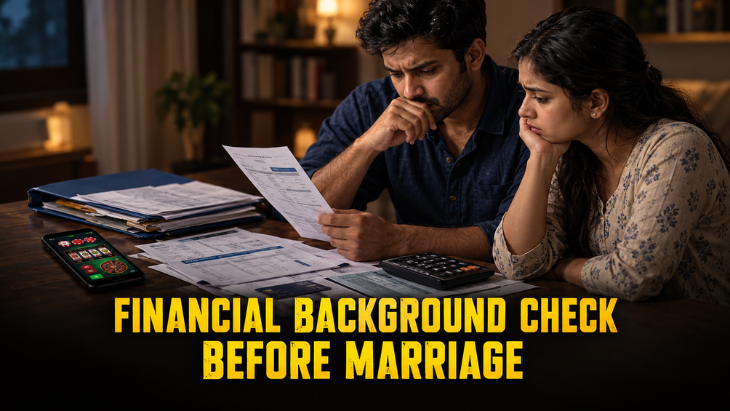
A financial background check before marriage verifies a prospective partner’s income, employment, debts, loans, credit behaviour and gambling habits through lawful sources. It helps families spot hidden financial risks early, so they can make an informed decision before the engagement or wedding.
Marriage joins two lives, and often two sets of money. Yet many families check only education, job title and family reputation. Financial facts get taken on trust. This guide explains what a financial check covers, how it works, what it may cost, and where professional help makes sense.
What Is a Financial Background Check Before Marriage?
It is a fact-finding process that confirms whether a person’s financial claims are true. It also looks for undisclosed financial burdens.
It usually checks:
- Stated income and employment details
- Existing loans, EMIs and unpaid dues
- Business or property claims
- Visible signs of gambling, betting or heavy speculation
- Court or recovery matters linked to money
It is a part of a wider pre-matrimonial investigation, which can also verify identity, marital status, education, family background and character. A financial check focuses on money-related facts only.
Why Does Financial Verification Matter Before Marriage?
Money problems affect daily life, safety and trust. A partner’s hidden debt can become a shared burden after marriage, especially in joint loans, joint accounts or family businesses.
Common reasons families ask for verification:
Exaggerated profiles
Salary, business size or property may be overstated in marriage proposals.
Hidden liabilities
Personal loans, credit card dues or borrowing from relatives may go unmentioned.
Addictive habits
Online betting, rummy, trading or casino spending can drain savings fast.
Peace of mind
Facts replace assumptions, and families can ask better questions.
A check does not predict the future. It gives you a clearer picture of the present.
What Can a Financial Background Check Reveal?
Hidden Debts and Loans
A check can help confirm whether the person has active loans, pending dues or recovery disputes. Where lawful records or consent-based documents are available, these can be compared with what the family has been told.
Income and Employment Claims
Investigators can verify whether the person works at the stated company, in the stated role, and for the stated period. Employment checks are among the most common parts of a groom or bride’s background check.
Gambling Habits and Risky Spending
Gambling is hard to see in documents. Verification here usually relies on discreet enquiries, public information and lawful observation of lifestyle patterns. Findings should be treated as indications that need further discussion, not as final proof.
Business and Asset Claims
Families sometimes hear about a “successful business” or “properties in the city.” Public records, registrations and local enquiries can help check whether such claims are reasonable.
Legal and Court Matters
Publicly available court records may show cheque bounce cases, recovery suits or fraud-related complaints. Availability differs by court and location.
Warning Signs of Hidden Financial Trouble
- These signs do not prove wrongdoing. They are reasons to look closer.
- Vague answers about income, employer or business
- Reluctance to share basic documents when reasonably asked
- Frequent requests for money or “temporary” help
- A lifestyle that does not match the stated income
- Sudden urgency to finalise the marriage
- Conflicting information from different people
- Talk of big wins, “sure” investments or betting
How Does a Pre-Matrimonial Financial Verification Work?
The steps depend on the case, but a professional process usually follows this order:
Consultation
You explain your concerns and what the family has been told.
Scope setting
The agency and client agree on what will be checked, such as employment, finances or family background.
Information collection
Details like name, address, workplace and claimed assets are shared.
Verification
Claims are checked through lawful methods, such as public records, employer confirmation and discreet enquiries.
Cross-checking
Findings from different sources are compared for consistency.
Report
The client receives a written report of what was found and what could not be confirmed.
A good report separates verified facts from unverified information. That distinction matters.
What Information Helps the Investigation?
The more accurate details you share, the more useful the verification. Helpful inputs include:
- Full name and age of the person
- Current and previous addresses
- Employer name and designation
- Business name, if any
- Phone number or social profile details shared in the proposal
- Photographs, marriage biodata and details from the matchmaker
- Specific doubts you want checked
Do not collect private documents through deception or pressure. Documents the person voluntarily shares are the safest route.
Is a Groom’s Background Check Different from a Bride’s?
The method is the same. The focus can differ based on family concerns.
Groom’s background check
Often centres on income, job stability, business claims, loans, habits and previous relationships.
Bride’s background check
Often centres on identity, education, employment, family details and any undisclosed financial or legal matters.
Both sides deserve the same fairness. Verification works best when families treat it as a mutual safeguard, not an accusation.
Cost of Background Verification: What Affects the Price?
There is no single fixed price. The cost of background verification depends on several factors:
- Number of checks requested (employment, finance, family, social)
- Number of cities or locations involved
- Depth of enquiry required
- Time needed to complete the work
- Difficulty in confirming information
A narrow, single-point check generally costs less than a full pre-matrimonial investigation. Ask for a written quote with the scope clearly listed before you proceed. Avoid agencies that quote an unusually low price without explaining what is covered.
Legal and Privacy Considerations
This section is general information, not legal advice. Laws on privacy and data access can vary, so consult a qualified lawyer for your situation.
- Legitimate verification relies on public information, consent-based documents and lawful enquiries.
- No ethical investigator should hack accounts, obtain private bank statements illegally or tap communications.
- Reports should be kept confidential and used only for the marriage decision.
- Findings should not be used to defame, blackmail or harass anyone.
If an agency promises access to someone’s private financial records without consent, walk away.
Mistakes to Avoid
Checking too late
Verify before engagement or heavy wedding spending, not after.
Relying only on the matchmaker
Intermediaries may not know the full picture.
Treating one finding as the whole story
Confirm important points before you decide.
Skipping a direct conversation
Honest talks about money, debts and expectations still matter.
Hiring on price alone
Check the agency’s process, confidentiality terms and reporting style.
Acting on rumours
Base decisions on verified facts.
When Should You Consider Professional Help?
Professional help is useful when:
- The person or family lives in another city
- Details seem inconsistent or unverifiable
- You have specific concerns about debt or gambling
- You do not have time or access to check claims yourself
- You want a clear written record of findings
Advance Detective Agency offers a Pre Matrimonial Investigation Service for families who want to verify facts before committing to a marriage. As a detective agency in Delhi, the team handles enquiries with confidentiality and by lawful means. Each case is discussed first, so the scope matches your concerns.
Frequently Asked Questions
1. What is a financial background check before marriage?
It is a lawful verification of a prospective partner’s income, employment, loans, debts and money-related habits. Its goal is to confirm what the family has been told and flag undisclosed financial risks before the marriage decision is final.
2. Can a background check reveal hidden loans?
Sometimes. Investigators may find loan-related information through public records, court matters, consent-based documents and discreet enquiries. They cannot lawfully access private bank records without consent, so some liabilities may remain unconfirmed.
3. How can I find out if my future spouse gambles?
Gambling is hard to confirm from documents. Discreet enquiries, lifestyle observation and open conversation can offer clues. Treat these as indicators, not proof, and discuss concerns directly with your partner as well.
4. Is a pre-matrimonial investigation legal in India?
Verifying public information and using consent-based documents is generally acceptable. Illegal methods such as hacking or unauthorised access to private data are not. Laws can vary, so consult a lawyer if you are unsure.
5. What is the cost of background verification before marriage?
Cost depends on scope, locations, depth and time required. A single-point check usually costs less than a full investigation. Ask for a written quote listing exactly what will be verified.
6. How long does a pre-marriage financial check take?
Time varies with the number of checks and how easily information can be confirmed. Simple employment checks may be quicker, while wider enquiries across cities take longer. The agency should give you a realistic timeline upfront.
7. What documents should I ask for from the other family?
You can reasonably ask for ID proof, employment details, a recent salary slip or business registration. Share requests politely and only ask for what is relevant. Voluntary disclosure builds more trust than pressure.
8. Is a groom’s background check different from a bride’s?
The process is the same, but the focus may differ. Groom checks often stress income, loans and habits. Bride checks often stress identity, education, employment and family details. Fair verification should apply to both.
9. Can I do a financial background check myself?
You can verify some things yourself, such as employer confirmation or asking for documents. Wider checks, especially across cities, are harder. A professional can help when records are scattered or details do not match.
10. What if the report shows a financial red flag?
Stay calm and verify the finding. Discuss it openly with the person and family, and ask for explanations or proof. You can then decide whether to proceed, pause or seek legal guidance.
Conclusion
A financial background check before marriage will not guarantee a perfect outcome. It does give you facts about debts, loans, income and habits before you make a lifelong commitment. Combine verified information with honest conversation, and keep the process lawful and respectful.
If you want a discreet, professional approach, you can speak with Advance Detective Agency about your pre-marriage verification needs. Share your concerns, agree on a clear scope, and make your decision with confidence.
Who Leads the Verification at Advance Detective Agency?
Every pre-marriage check at Advance Detective Agency runs under the direction of its Founder-Director, Hardesh Bhardwaj. He started the agency in 2013 and has since overseen more than 3,000 cases.He has witnessed how frequently a family’s faith is based on information that no one has verified, such a supposed salary, an unmentioned loan or a hidden betting habit.
In 2026, at its annual conference in Cannes, the World Association of Detectives (WAD) named him Investigator of the Year. Founded in 1925, WAD is described as the world’s oldest association of private investigators.
That experience shapes how the agency handles marriage-related financial checks. Enquiries rely on lawful methods, client details stay confidential, and findings go into a written, evidence-based report. The report separates what was confirmed from what could not be verified.