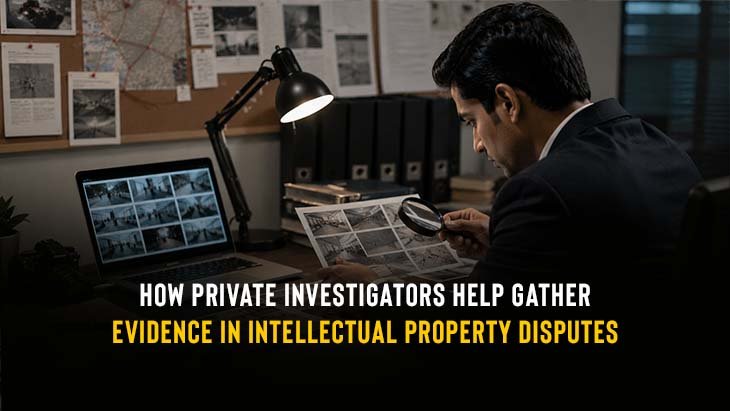
intellectual property investigation (IP) dispute can occur when a company thinks its trademarks, copyrighted content, trade secrets, designs, patents, or other intellectual property are being infringed. In the business world, these conflicts can lead to monetary loss, loss of reputation, unfair competition and the leakage of confidential information.
private investigators can help businesses gather factual, legally obtained information that may support an intellectual property dispute. Their duties may involve the discovery of suspected infringement, logging activities, carrying out background investigations, trace business relationships and obtaining information from publicly available and legally accessible sources.
For businesses facing possible IP infringement, professional investigation might offer an impartial common-sense fact-finding before you proceed to more legal action.
What Is an Intellectual Property Dispute?
An intellectual property dispute is a dispute between two or more parties which concerns ownership of, use of, reproduction of, distribution of, or exploitation of IP.
Common examples include:
- Trademark infringement
- Copyright infringement
- Patent-related disputes
- Trade secret misuse
- Counterfeit products
- Unauthorized reproduction of designs
- Brand impersonation
- Unauthorized use of proprietary business information
- Online infringement
- Distribution of unauthorized products
In many instances, the core issue isn’t just whether an infringement has occurred or not, but establishing reliable facts about who is responsible, how the infringement is occurring, and what evidence connects the activity to the suspected party.
That’s where a private investigator could help.
How Private Investigators Help in Intellectual Property Investigations
Private investigators have to employ various investigative techniques given the circumstances of the dispute, the information at their disposal and the law.
1. Identifying the Source of Infringement
The first step in infringing is to be able to identify where it is coming from.
Investigators may examine:
- Business records that are lawfully accessible
- Public company information
- Websites and online profiles
- Marketplace listings
- Social media activity
- Advertising information
- Publicly available contact details
- Business relationships and affiliations
This can help to create links between an infringing activity and an individual or organisation.
2. Investigating Counterfeit Products
Brands that invest heavily in their brands are concerned about counterfeiting.
Private investigators may assist in determining:
- Where suspected counterfeit products are being sold
- How products are being distributed
- Whether multiple sellers are connected
- Where the products are being advertised
- Whether a physical business location is involved
- Potential links between distributors and suppliers
There may be potential links between distributors and suppliers.
In the case of a company finding the unauthorized use of its trademark on an online marketplace, the investigator could take notes about the listing and investigate any publicly available information the investigator has about the seller.
3. Conducting Trademark Infringement Investigations
A trademark dispute could be about the unauthorized use of a company’s name, logo, symbol, packaging, slogan or other identifying features.
An investigator may establish a record of cases and activities involving the suspected party using similar or identical branding in a commercial activity.
Investigation may include:
- Recording publicly accessible website information
- Documenting advertisements
- Examining business listings
- Reviewing marketplace activity
- Identifying physical locations
- Establishing links between businesses
The goal is to develop a factual record that’s available to the client and their attorney.
4. Gathering Evidence of Copyright Infringement
Breach of copyright may include copying or distribution of any of the following:
- Website content
- Photographs
- Videos
- Software
- Marketing materials
- Publications
- Graphics
- Product descriptions
- Training materials
Investigators can assist in the documentation of the location of copyrighted material, when the copyrighted material was found, its use, and the relationship of the alleged infringer to the affected business.
Careful evidence gathering and preservation should be done so that the authenticity of the evidence and its source can be explained later.
5. Investigating Trade Secret Misappropriation
Trade secret issues may be highly charged as information may have high commercial value.
Examples may include:
- Customer databases
- Pricing information
- Manufacturing processes
- Business strategies
- Supplier information
- Proprietary methodologies
- Confidential technical information
When there is a suspected violation of employee or competitor conduct, investigators will be able to investigate in a lawful manner in order to determine relevant facts.
Protected information should not, however, be gained by hacking, unauthorized access, impersonation or other illegal means.
6. Employee and Insider Investigations
In some cases, an IP dispute will include current or former employees.
An employer might have reason to believe that an employee has:
- Shared confidential information
- Taken proprietary documents
- Joined a competitor and improperly used confidential knowledge
- Copied business materials
- Misused customer information
- Disclosed trade secrets
A private investigator can investigate all relevant activities and relationships, under the law.
It’s not meant to point fingers at the wrong party, but to provide facts that will be helpful for the organization and legal counsel to decide on the next steps.
7. Online Investigation and Digital Footprint Analysis
Intellectual property disputes are increasingly about online platforms.
Investigators can look at publicly available data from:
- Websites
- Social media
- Online marketplaces
- Business directories
- Public advertisements
- Review platforms
- Publicly available corporate information
Such investigations may be useful in uncovering recurring issues like protected branding, false product listings, plagiarized content, and links between seemingly standalone sellers.
Care should be taken in preserving digital information because things can change on the Internet, and information can be lost.
8. Background Investigation of Suspected Parties
It may be relevant to know who infringed if the infringement is suspected.
A private investigator can run a background check on a person or business on legal sources.
This can assist in establishing:
- Business ownership
- Company relationships
- Previous business names
- Professional associations
- Publicly available business records
- Commercial activities
- Connections between related entities
The two entities are linked by their connections. The two entities are related through connections.
This information can assist legal teams in getting a better grasp of the overall situation in an IP dispute.
9. Surveillance in Intellectual Property Cases
In some instances, it may be justifiable to use physical surveillance where it is part of a legitimate investigation and can be carried out lawfully.
For instance, any observable activity that can be made public can be recorded by investigators, such as:
- Suspected counterfeit distribution
- Commercial operations
- Movement of products
- Business locations
- Meetings relevant to the investigation
Surveillance must always adhere to any privacy laws and legal restrictions that may apply. Investigators must not trespass, intercept communications or engage in prohibited monitoring.
10. Evidence Documentation and Investigation Reports
The information collection is not the only component of an investigation. The information should be structured logically as well.
A professional investigator may prepare a report that includes a structured report with the following:
- Investigation objectives
- Dates and locations
- Investigative methods
- Factual observations
- Photographs where lawfully obtained
- Public-source information
- Relevant documents
- Identified business connections
- Chronology of events
A clear report can assist to a client and his or her representatives to comprehend what was discovered during the investigation.
What Types of Evidence Can Private Investigators Gather?
In some instances, investigators will gather or document data about:
| Evidence Type | Potential Use |
| Photographs | Documenting publicly observable activities |
| Website records | Showing online use of protected content or branding |
| Marketplace listings | Documenting suspected counterfeit sales |
| Business information | Establishing company relationships |
| Public advertisements | Documenting commercial activity |
| Background information | Understanding parties involved |
| Surveillance observations | Recording relevant activities lawfully |
| Investigation reports | Organizing findings chronologically |
The value of any material as evidence is determined by the facts and by the law. A private investigator is not the one who decides what evidence is admissible in court, this is typically done by the legal community, or the court itself.
Why Businesses Use Private Investigators for IP Disputes
Professional investigators can be considered by business when it needs additional in-depth fact finding that it is unable to do itself.
Independent Investigation
It is possible for an external investigator to conduct an investigation outside of the company’s normal business practices.
Faster Information Gathering
An investigator who has a background in inquiry and investigative work can reconstructively search and use investigative leads efficiently.
Local Investigation Support
If the alleged infringement is over a specific city or region then a local investigation team could be able to carry out field verification and record the activities which are publically observable more efficiently.
Confidentiality
IP disputes may have confidentiality requirements. The professional investigator will typically act discreetly and keep confidentiality.
Support for Legal Strategy
Investigation results may yield facts that can be of use to a company’s attorney in determining legal options.
Is Evidence Collected by a Private Investigator Admissible in Court?
Not automatically. A Private Investigators report will have potential evidentiary value if it gathers evidence in accordance with the applicable laws and procedural requirements of the case.
Investigator must ensure that proper lawful means and documentation is used when obtaining information.
For example, investigators should avoid:
- Unauthorized access to computer systems
- Hacking
- Illegal interception of communications
- Trespassing
- Impersonation for unlawful purposes
- Theft of confidential documents
- Unlawful tracking or surveillance
Also, firms must have expert legal advice on gathering, preserving, and utilizing evidence in an IP case.
When Should a Business Hire a Private Investigator for an IP Dispute?
A business might want to investigate when they see:
- Counterfeit products appearing in the market
- Unauthorized use of a brand name or logo
- Competitors using suspiciously similar materials
- Company content appearing on another website
- Confidential information appearing outside the organization
- A former employee allegedly sharing proprietary information
- Unauthorized sellers operating online
- Suspicious distribution networks
- Repeated infringement despite warnings
Early investigation will enable a business to assess the situation in order to determine if legal or business action is warranted.
How to Choose a Private Investigator for an Intellectual Property Investigation
When selecting an investigation agency, it is key that the right agency is used in case commercially sensitive information is involved in the IP case.
Businesses should consider:
Relevant Investigation Experience
Inquire if the agency has dealt with any corporate investigations, background checks, surveillance, counterfeit, or IP-related investigations.
Legal and Ethical Investigation Methods
The agency should make it clear what investigative techniques it employs and should not guarantee that it will be able to provide access to information that cannot be lawfully obtained.
Confidentiality
The investigator should have safeguards in place for confidential information in the business.
Clear Reporting
Inquire if the agency prepares reports and supporting documents of investigations that are organized.Request if the agency prepares organized investigation reports and supporting documents.
Geographic Coverage
If the investigation is being conducted at several sites, a business might want to use an agency that has investigation powers in the appropriate cities and regions.
Intellectual Property Investigation Services in India
Indian businesses could face IP problems in various markets, manufacturing bases, commercial premises and online platforms.
A Detective agency in Delhi could help conduct a corporate investigation, counterfeit investigation, employee investigation, background check, surveillance and other investigations to prove a suspected violation of intellectual property rights.
When physical verification is necessary, local investigation support may be beneficial for businesses located in cities like Delhi, Mumbai, Bengaluru, Hyderabad, Chennai, Pune, Kolkata, Ahmedabad, Noida, Gurugram, or elsewhere.
But all investigations must be conducted in line with the nature of the dispute and Indian laws.
Frequently Asked Questions
1. Can a private investigator investigate intellectual property infringement?
Yes. Private investigators can help in the fact-finding process in connection with suspected IP infringement, such as locating possible infringers, recording the public activities, tracing business relationships, and conducting counterfeit distribution investigations.
2. What can a private investigator do in an IP dispute?
An investigator can perform background research, Internet investigations, surveillance (where legal), counterfeit investigations, business verification, and documentation of evidence.
3. Can private investigators investigate counterfeit products?
Yes. Investigators can assist in determining the identity of suspected counterfeit sellers, compile a list of publicly posted listings, explore distribution networks, and carry out legitimate field verification.
4. Can investigators find who is behind an anonymous online seller?
They might be able to access information that can be useful with legal access and publicly available resources. Investigators cannot ensure identification, however, in all cases, especially when an individual intentionally attempts to keep their identity hidden.
5. Can private investigators collect evidence for court cases?
They have the ability to gather and record information through proper investigative techniques. Applicability of law and procedure, authenticity and circumstances of collection all play a part in determining whether or not the evidence is admissible in court.
6. Can a private investigator investigate a former employee for trade secret misuse?
It is acceptable for an investigator to carry out a lawful investigation of potentially relevant activities, relationships and publicly available information in the context of a legitimate business concern.
7. Is online investigation useful for intellectual property disputes?
Yes. Useful investigative leads and documentation can be found in websites, marketplaces, social media, advertisements, and other areas that are available to the public electronically.
8. How long does an intellectual property investigation take?
The length of time will be determined by the complexity of the case, the number of parties and locations, the type of IP involved, and the amount of evidence acquired.
9. Should a business contact a lawyer before hiring an investigator?
There may be times it is wise to consult with competent legal representation, especially where the investigation might result in action for litigation or confidential information is shared.
10. Why hire a professional investigator for an IP dispute?
An independent professional investigator can offer the business structured fact finding and can assist in determining facts that may be more difficult to the business to verify on its own.
Key Takeaway
Intellectual property disputes may involve intricate groups of people, companies, online vendors, past employees, distributors, and competitors. Private investigators can support these cases by conducting lawful research, identifying investigative leads, documenting suspected infringement, investigating counterfeit activities, and preparing organized factual reports.
An investigation’s purpose is not to establish a desired conclusion but to establish sound facts. Coordination of investigation with appropriate legal guidance helps businesses to properly respond to suspected violations of the IP rights.
Businesses with possible trademark infractions, copyright violations, counterfeiting, trade secrets issues, and other IP related problems can benefit from professional investigation as a fact-finding tool.