
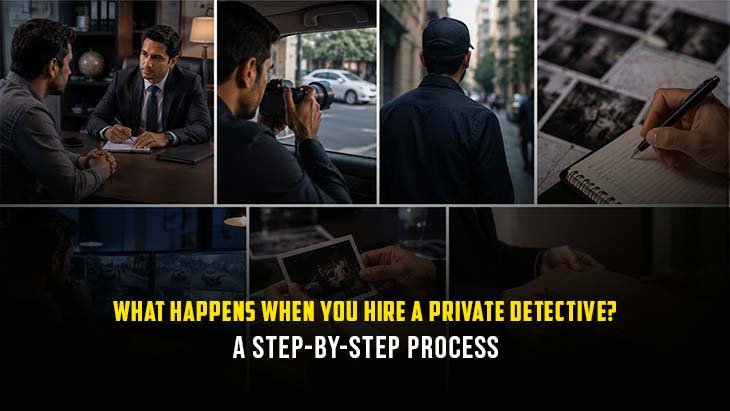
When you first put into action the idea of hire a private detective agency, you may feel like it is too much to handle. From matrimonial disputes to employee misconduct cases, fraud cases or missing person cases, knowing the private detective investigation process can help you know what to expect. When hiring a private detective in India, it is essential to understand the process they use to obtain facts and present reliable evidence; a professional private detective follows a structured, confidential, and legally compliant approach.
Quick Answer
The first step in obtaining the services of a private detective is to have a confidential discussion with him or her about what you are concerned with. The investigator reviews your case and formulates an investigation plan, legally gathers evidence, monitors activity if required, analyses evidence, and provides a comprehensive investigation report. In all stages of this process, client confidentiality is a primary concern, as is ethical investigation practices. This step-by-step private investigation process is designed in such a way that each and every time which the client calls a private detective, he will be aware of what to anticipate from a private detective investigation, from the initial phone call to the last report.
Why Do People Hire a Private Detective?
Private detectives can help people, businesses and lawyers in discovering facts that may be hard to find on their own. They don’t just break the law, as is sometimes shown in films, but observe, research, interview, monitor and gather evidence in keeping with the law. Once Understanding how private detectives work, it becomes easier to understand the reasons behind the use of private investigation services by many people and companies.
There are several reasons why people hire a private detective:
- Pre-Matrimonial investigations
- Employee background verification
- Corporate fraud investigations
- Missing person investigations
- Surveillance services
- Asset verification
- Insurance fraud investigations
- Due diligence investigations
Every case has a systematic private detective case handling process which guarantees accuracy, confidentiality and professionalism.
Step 1: Initial Confidential Consultation
The first step is a private investigator consultation between you and the private detective, which is kept confidential. This meeting enables the investigator to learn more about your concerns, your goals and your expectations.
At the time of consultation, you might be required to supply:
- A detailed description of the issue
- Relevant names and contact information
- Important dates and locations
- Available documents or photographs
- Any previous evidence already collected
The detective also provides an explanation of what is legally allowed to be investigated, the timelines, what may come back and how the investigation will be conducted.
This is crucial because a knowledgeable and professional private detective can plan a more effective investigation.
Step 2: Case Evaluation and Feasibility Assessment
Not all enquiries need to be investigated in full. The detective assesses the case before accepting it as suitable, legal and likely to yield a useful outcome.
The assessment considers factors such as:
| Evaluation Factor | Purpose |
| Nature of the case | Understand investigation requirements |
| Available information | Assess existing evidence |
| Legal considerations | Ensure compliance with applicable laws |
| Time sensitivity | Prioritize urgent matters |
| Investigation complexity | Estimate resources required |
Step 3: Investigation Planning
The detective then creates a specific investigation plan to address the case.
The plan will vary according to the type of case:
- Surveillance schedules
- Background research
- Document verification
- Digital evidence review
- Witness interviews
- Location visits
- Public record searches
Each investigation is different, and the strategy is tailored to meet your objectives, but is also kept confidential.
Step 4: Evidence Collection
All investigations are built on evidence. Understanding how private investigators collect evidence legally involves gathering factual information, as opposed to assuming or speculating, a key part of understanding how private investigators collect evidence legally.
Evidence may include:
- Photographs
- Videos
- Witness statements
- Public records
- Business documents
- Digital communications (where legally permissible)
- Location observations
- Timeline documentation
In a corporate investigation, for instance, the detective can check the company’s employment records and obtain publicly available company data. In a matrimonial case, surveillance and documentation is allowed to substantiate or discredit particular issues.
Step 5: Surveillance and Field Investigation
Surveillance is one of the most well-known functions of a private investigator, but it is only utilised when it is needed. Observations are carefully made to record what the subject is doing and not to disrupt the observation.
Examples include:
- Monitoring routine movements
- Verifying meetings
- Observing business activities
- Confirming residential information
Professional surveillance is carried out with care to ensure accuracy and adhere to the legal limits.
Step 6: Regular Progress Updates
A trustworthy private investigator informs the client throughout the investigation. Some aspects of the operation will be kept confidential to preserve the integrity of the investigation but the client is regularly updated about the progress.
These changes can be among the following:
- Investigation milestones
- Completed activities
- Additional information required
- Changes to the investigation plan
- Expected completion timeline
Clients are kept informed without interference to the investigation with transparent communication.
Step 7: Analysis and Verification
Gathering evidence is just a part of the process. All findings must be analysed and verified by investigators before coming to conclusions.
This involves:
- Cross-checking information
- Verifying witness statements
- Organizing timelines
- Reviewing photographs and videos
- Eliminating inconsistencies
Verified facts only are included in the actual investigation report, which provides objective and reliable results.
Step 8: Final Investigation Report
The detective finishes his/her investigation and writes a detailed report of what was done and what evidence was found.
A professional investigation report typically will contain:
- Case background
- Investigation objectives
- Methodology
- Evidence collected
- Timeline of events
- Findings
- Supporting photographs or documents (where applicable)
- Recommendations or observations
The report is clear and factual, with no needless opinions or assumptions.
What Information Should You Share with a Private Detective?
Giving accurate information helps the investigation to be more effective. Here are some tips for what information you should provide a private investigator before your first meeting.
Helpful checklist:
- Full names
- Recent photographs
- Addresses
- Phone numbers
- Social media details
- Vehicle information
- Known routines
- Relevant documents
The investigation process may be delayed if false or incomplete information is provided, and the findings may be less quality.
What Factors Affect the Cost of Hiring a Private Detective?
Private detectives in India are not charged a predetermined amount, but rather based on criteria such as the extent of the investigation.
| Factor | Effect on Cost |
| Investigation duration | Higher duration generally increases cost |
| Number of investigators | More personnel may increase expenses |
| Travel requirements | Long-distance travel adds costs |
| Surveillance hours | Extended surveillance requires additional resources |
| Complexity of the case | Complex investigations require more time and expertise |
Benefits of Hiring a Professional Private Detective
Working with an experienced investigator offers several advantages:
- Confidential handling of sensitive information
- Objective and evidence-based findings
- Legally compliant investigation methods
- Professional documentation
- Time-saving expertise
- Better decision-making through verified information
- Reduced personal risk compared to conducting independent investigations
These benefits make professional private detective services valuable for both personal and corporate matters, and explain why demand for reliable private investigation services continues to grow across India.
Frequently Asked Questions
How long does a private investigation take?
The duration depends on the complexity of the case. Some investigations may take a few days, while others require several weeks.
Is my identity kept confidential?
Yes. Professional detective agencies maintain strict confidentiality and only share information with authorised individuals involved in the case.
Will I receive regular updates?
Most professional investigators provide periodic updates so clients remain informed about the progress of the investigation.
Can private detectives collect evidence legally?
Yes. Licensed and professional investigators use lawful and ethical methods to gather information while respecting applicable legal requirements — this is central to understanding how private investigators collect evidence legally.
Will I receive a written investigation report?
Yes. Upon completion, clients generally receive a detailed report summarising the investigation, evidence collected, and factual findings.
How do I hire a private detective in India?
The process starts with a confidential consultation, followed by case evaluation, investigation planning, evidence collection, and a final report — the same private detective investigation process outlined above.
Conclusion
Hiring a private detective is a structured and professional process designed to uncover facts while protecting your privacy. From the initial consultation and investigation planning to surveillance, evidence collection, and final reporting, every stage is carried out with discretion, objectivity, and legal compliance. Understanding how private detectives work and what happens during a private investigation helps clients make informed decisions and sets realistic expectations.
If you are considering professional investigation services, choose an experienced detective agency that emphasises confidentiality, transparent communication, ethical practices, and evidence-based reporting. A trusted professional private detective can provide the clarity and information needed to make confident personal or business decisions.