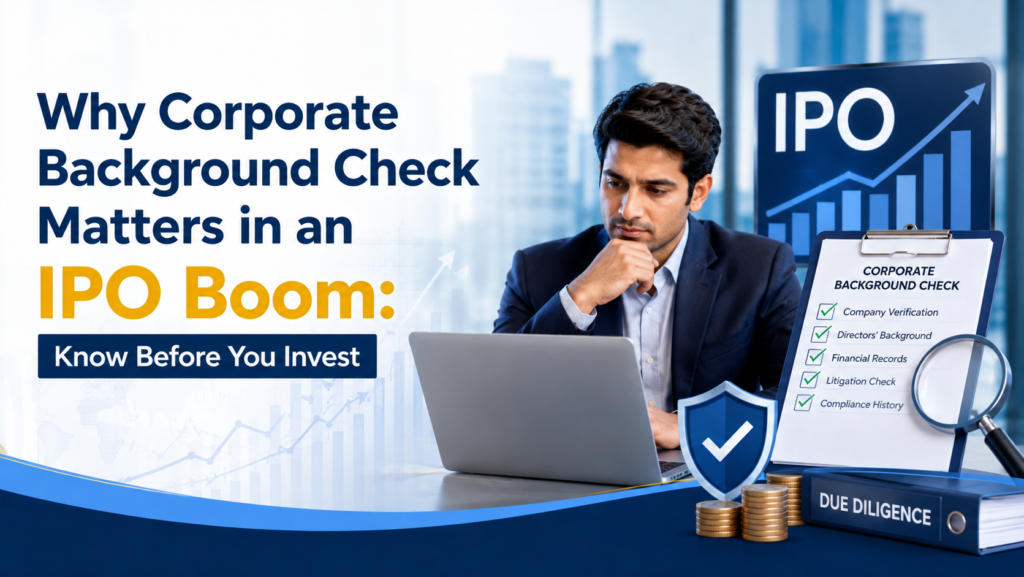
Corporate Background Check (due diligence) matters in an IPO boom because it helps investors verify a company’s financial health, promoter background, legal standing, and business claims before money is committed. During high-activity IPO periods, hype often outpaces verified information, making independent checks essential to avoid misplaced trust and financial loss.
What Is Corporate Due Diligence?
Corporate due diligence is the process of independently verifying facts, documents, and claims about a company before entering into a financial relationship with it. In the context of an Initial Public Offering (IPO), this means examining the company’s promoters, financial statements, legal history, and business operations beyond what is presented in the prospectus or marketing material.
It is not the same as reading a company’s annual report or IPO brochure. Due diligence involves cross-checking public records, verifying ownership structures, and identifying red flags that may not be visible in official filings alone.
Why Corporate Due Diligence Matters in an IPO Boom
An IPO boom is a period when a large number of companies list on stock exchanges within a short span, often driven by strong market sentiment and investor enthusiasm. While this creates opportunities, it also increases certain risks that make due diligence important.
Faster listings mean less scrutiny time
When many companies file for IPOs together, regulators, analysts, and the media have limited bandwidth to examine each one in depth.
Herd mentality drives decisions
Investors sometimes subscribe to an IPO because others are doing so, not because they have verified the company’s fundamentals.
Promoter background is not always visible
Past business failures, litigation, or regulatory actions involving promoters may not be prominently disclosed.
Related-party transactions can be complex
Some companies structure transactions with group entities in ways that are hard to interpret from financial statements alone.
NSE stock listings attract retail investors quickly
Once a company is listed on an exchange like the NSE, trading activity can begin almost immediately, leaving little time for investors to research after the fact.
Understanding this environment is why due diligence matters in an IPO boom more than during quieter market periods.
What a Corporate Due Diligence Works Before Investing in an IPO
Due diligence generally follows a structured approach rather than a single check. Below is how the process typically unfolds.
1. Reviewing Public Filings and Disclosures
This includes examining the IPO prospectus (Draft Red Herring Prospectus and Red Herring Prospectus), regulatory filings, and past financial disclosures made to authorities such as SEBI and the Registrar of Companies.
2. Verifying Promoter and Management Background
This step looks at the professional history of key promoters and directors, including any past company closures, litigation, regulatory penalties, or disputes that may not be highlighted in the IPO documents.
3. Checking Legal and Litigation History
Ongoing or past legal cases involving the company, its promoters, or group entities are reviewed. This can include civil disputes, regulatory proceedings, or criminal matters that may affect the company’s credibility.
4. Assessing Related-Party and Group Company Transactions
Many companies operate within a larger group structure. Reviewing transactions between the listing company and its related entities helps identify whether business relationships are conducted at fair value or raise concerns.
5. Verifying Business Claims and Operational Details
Some companies make claims about client relationships, market share, or operational scale in their marketing material. Independent verification helps confirm whether these claims are consistent with available evidence.
6. Financial Statement Analysis
This involves reviewing audited financial statements, auditor remarks, and any qualifications or notes that may indicate underlying concerns not obvious from headline numbers alone.
Documents and Information Typically Reviewed During Due Diligence
- Draft Red Herring Prospectus (DRHP) and Red Herring Prospectus (RHP)
- Audited financial statements and auditor reports
- Registrar of Companies (RoC) filings
- Court and litigation records, where publicly available
- Promoter and director background information
- Related-party transaction disclosures
- Regulatory correspondence or penalty history, where disclosed
Benefits of Corporate Due Diligence in an IPO Boom
- Reduces the risk of investing based on incomplete information.
- Helps identify promoter or management concerns early.
- Supports informed decision-making instead of decisions based on market hype.
- Adds a layer of verification beyond what is stated in official documents.
- Helps investors, business partners, or stakeholders assess credibility before financial commitment.
Common Concerns Investors Have About IPO Due Diligence
Is the Information in the IPO Prospectus Enough?
The prospectus is a legally mandated disclosure document, but it is prepared by the company and its advisors. While it must meet regulatory disclosure standards, independent verification can help confirm that disclosures are complete and consistent with other available records.
Can Due Diligence Guarantee a Good Investment Outcome?
No. Due diligence reduces informational risk by verifying facts and identifying red flags, but it does not predict stock price performance or guarantee returns. Investment decisions still involve market risk.
Is Due Diligence Only for Large Investors?
Due diligence is useful for any investor, business, or stakeholder who wants to verify facts before committing money, not only large institutional players.
Mistakes to Avoid When Evaluating an IPO
- Relying only on media hype or social media sentiment.
- Skipping the litigation and background history of promoters.
- Ignoring related-party transactions in the financial statements.
- Assuming exchange listing (such as on the NSE) means the company has been independently vetted for investment suitability.
- Treating past financial performance as a guarantee of future results.
When Professional Due Diligence Assistance May Be Useful
Individual investors can review publicly available filings on their own, but verifying promoter background, litigation history, and business claims in depth often requires structured research and access to varied public record sources. This is where professional due diligence support becomes useful, particularly for:
- Business partners or investors evaluating a company before a significant financial commitment.
- Stakeholders who want an independent verification layer beyond the company’s own disclosures.
- Cases where promoter or management background needs closer examination.
Advance Detective Agency assists with Due Diligence Investigations that involve lawful, evidence-based verification of corporate backgrounds, promoter history, and related business information. The approach is based on ethical and legal investigation methods, with confidentiality maintained throughout the process. This kind of verification is meant to support informed decision-making, not to replace independent financial or legal advice.
Corporate Due Diligence and Investment Decisions: What to Keep in Mind
Due diligence should be treated as one part of a broader decision-making process. It works alongside financial analysis, market research, and professional advice, rather than replacing them. Investors are encouraged to consult qualified financial and legal professionals before making investment decisions, especially for significant commitments during an active IPO market.
Conclusion
Corporate due diligence matters in an IPO boom because rapid listing activity can outpace the time available for thorough public scrutiny. Verifying promoter background, financial disclosures, litigation history, and related-party transactions helps investors make decisions based on verified information rather than market momentum alone. As NSE stock listings continue to attract investor interest during active IPO periods, taking the time to verify company information remains a practical step toward informed investing. For those who need structured, lawful, and confidential verification support, working with a professional agency such as Detective agency in Delhi — Advance Detective Agency — can add a useful layer of independent diligence to the decision-making process.
Frequently Asked Questions
1. What is included in a due diligence check?
A due diligence check typically includes company background, ownership, promoters, financial records, legal history, regulatory compliance, business operations, and potential risks.
2. What is a red flag due diligence report?
A red flag due diligence report identifies important concerns such as financial irregularities, undisclosed liabilities, legal disputes, regulatory issues, or inconsistencies in company information.
3. What is a DD checklist (due diligence checklist)?
A DD checklist is a structured list of documents and information used to review a company’s financial, legal, operational, ownership, and compliance background before making an investment or business decision.
4. What are red flags in due diligence?
Common red flags include unexplained financial discrepancies, ongoing legal cases, regulatory violations, undisclosed related-party transactions, high debt, and inconsistencies in company disclosures.
5. What are the three P’s of due diligence?
The three P’s are commonly described as People, Process, and Performance. They help assess the company’s management, business practices, and track record.
6. What is considered a bad background check result for a company?
A bad background check may reveal serious legal disputes, financial irregularities, regulatory violations, misleading disclosures, undisclosed liabilities, or concerns involving promoters or key management.
7. What is corporate due diligence before investing in an IPO?
Corporate due diligence before an IPO involves reviewing the company’s promoters, management, financial performance, legal records, business model, risks, regulatory disclosures, and other available information before investing.
8. Why is due diligence important during an IPO boom?
Due diligence is important during an IPO boom because increased market interest can make investors focus on potential returns. A proper review helps investors understand a company’s risks, financial position, management, and disclosures before investing.
9. How can investors check a company’s background before an IPO?
Investors can review the company’s IPO documents, financial statements, promoter information, legal disclosures, regulatory filings, business history, and other publicly available records.
10. Is SEBI approval enough to trust an IPO company?
No. SEBI’s regulatory review does not mean an IPO is risk-free or guarantee investment returns. Investors should independently review the company’s disclosures, financial position, risks, and business fundamentals.
11. What documents should investors verify before an IPO investment?
Investors should review the DRHP, RHP, financial statements, risk factors, promoter details, material legal proceedings, related-party transactions, and other relevant IPO disclosures.
12. How to check promoter background before investing in an NSE stock?
Investors can review promoter information, shareholding details, regulatory disclosures, legal proceedings, company filings, and publicly available records to assess the promoter’s background.
13. What are common red flags in an IPO prospectus?
Common red flags include high debt, declining financial performance, significant legal disputes, related-party transactions, promoter concerns, regulatory issues, and substantial dependence on a small number of customers or suppliers.
14. Can retail investors do their own due diligence on an IPO company?
Yes. Retail investors can review IPO documents, financial statements, promoter information, risk factors, regulatory filings, and other publicly available company information before investing.
15. When should investors hire a professional agency for IPO due diligence?
Investors may consider professional due diligence when they need deeper verification of a company’s promoters, business background, legal history, ownership, financial information, or other risks that are difficult to assess independently.